My Experience with Educational Technology and Response to EdTech Article
I was born in the early 2000s, so my experience and the experiences of my peers with technology in education is different than that of people born before technology became so advanced.
In early elementary school, I remember always having the rolling carts with televisions on them. We also had a class Leapfrog tablet with the books that you insert and it reads to you. One teacher that I had in elementary school had an overhead projector where she would write on a piece of paper and we could see it on the board behind her. Later in elementary school we had SmartBoards.
Fun Story: It started with just one SmartBoard, and the school gave it to the oldest crankiest teacher. You could not find someone who despised technology more. I assume they did this because they didn't want to implement SmartBoards, but it backfired when this teacher LOVED her SmartBoard. I remember she invited classes in to watch her calibrate the pen and write things on the board because she was just so fascinated with it.
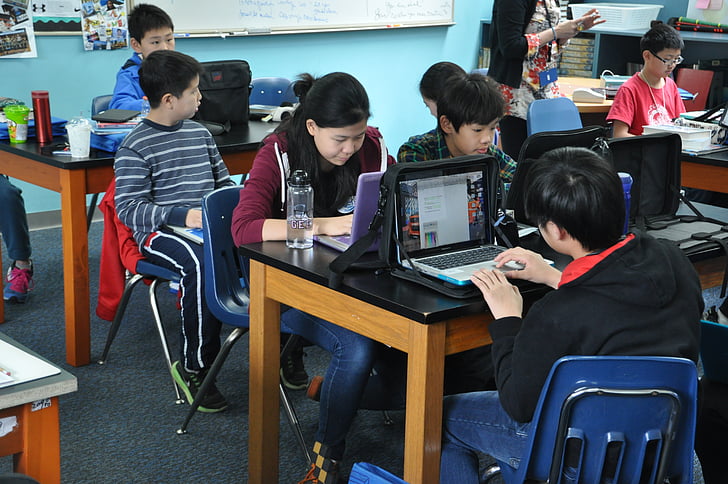
By the time I was in middle school, we had SmartBoards in practically every classroom. In middle school we also started typing class. We would be sent down to the computer lab and we would have to type along with this typing program. After a year of typing class, my school received some type of grant that gave every student in the district a school-use Chromebook. The Chromebooks were mostly used for research in the beginning, then teachers started discovering sites like Kahoot, Quizlet, Quizziz, etc.
In high school, a lot of the technology stayed the same. A lot of teachers actually asked for their smart boards to be removed and started projecting their computer screens onto a white board. Then in my Sophomore year COVID-19 hit, so we slowly went to virtual learning. My school used Google Meets as a way of meeting for class and Google Classroom to organize our assignments. Since being in college, I have not used much more than my laptop for school, but I am in music education. Maybe a more STEAM related major has been able to play with cooler technology.
I think that technology could be utilized in ways that make education more fun, but I also think that it depends on how people use the technology. SmartBoards were supposed to be used to play new educational games and have a whole class collaborate on a digital activity, but my teachers only every used them as whiteboards. It started as a great idea with so many opportunities, but it wasn't utilized properly in the classroom which made it ineffective.After reading Neil Jarrett's How EdTech is Changing the Face of Education, I think it reinforced my beliefs about technology and education. Like Jarrett references, technology can evolve the world of education. It offers so many opportunities for people to learn in ways that better suit them. I think that issues arise when you add in teachers who aren't using the technology properly, students who don't care about school, and administration that will try to find the cheapest way to implement technological changes. This is again shown with the use of SmartBoards. Many teachers did not utilize the SmartBoard for what it was meant for, so the students did not benefit from the technology.
Jarrett does address teachers being properly trained on using the new classroom technology as well as a few other factors, but I still think that the technology will be misused. I am not saying that classroom technology shouldn't be used. I do think that we should keep finding ways to make education better, but I also think that things as far as VR classroom experiences may be more distracting than helpful, even with trained staff.
I also think that a big issue with educational technology would be the inequality in access to advanced teaching tools. Not every district can afford these teaching tools, which creates such a huge difference in the experiences of students from one district to another. We are worsening an already existing situation where quality of education is unequal for students in low income areas. On top of this is the fact that many underfunded districts are the districts with a large percentage of people of color.
Once again, this isn't the fault of the technology. The technology is great. The issues arise when you can't effectively and equally implement the technology in classrooms, which seems to be an impossible task when we can't even equally distribute things as basic as textbooks.


I'm hearing you on the equity issue! We used to call this the digital divide; and there were lots of grants and pushes for 1:1 devices. But we learned that it's not enough to send an iPad or laptop home with a student; the inequity is so much deeper. Lack of appropriate professional development, lack of internet access at home, families who may not know how to get their kids logged in or access to apps or are unable to otherwise troubleshoot; language barriers at home, etc. We have a lot to talk about it!
ReplyDelete